

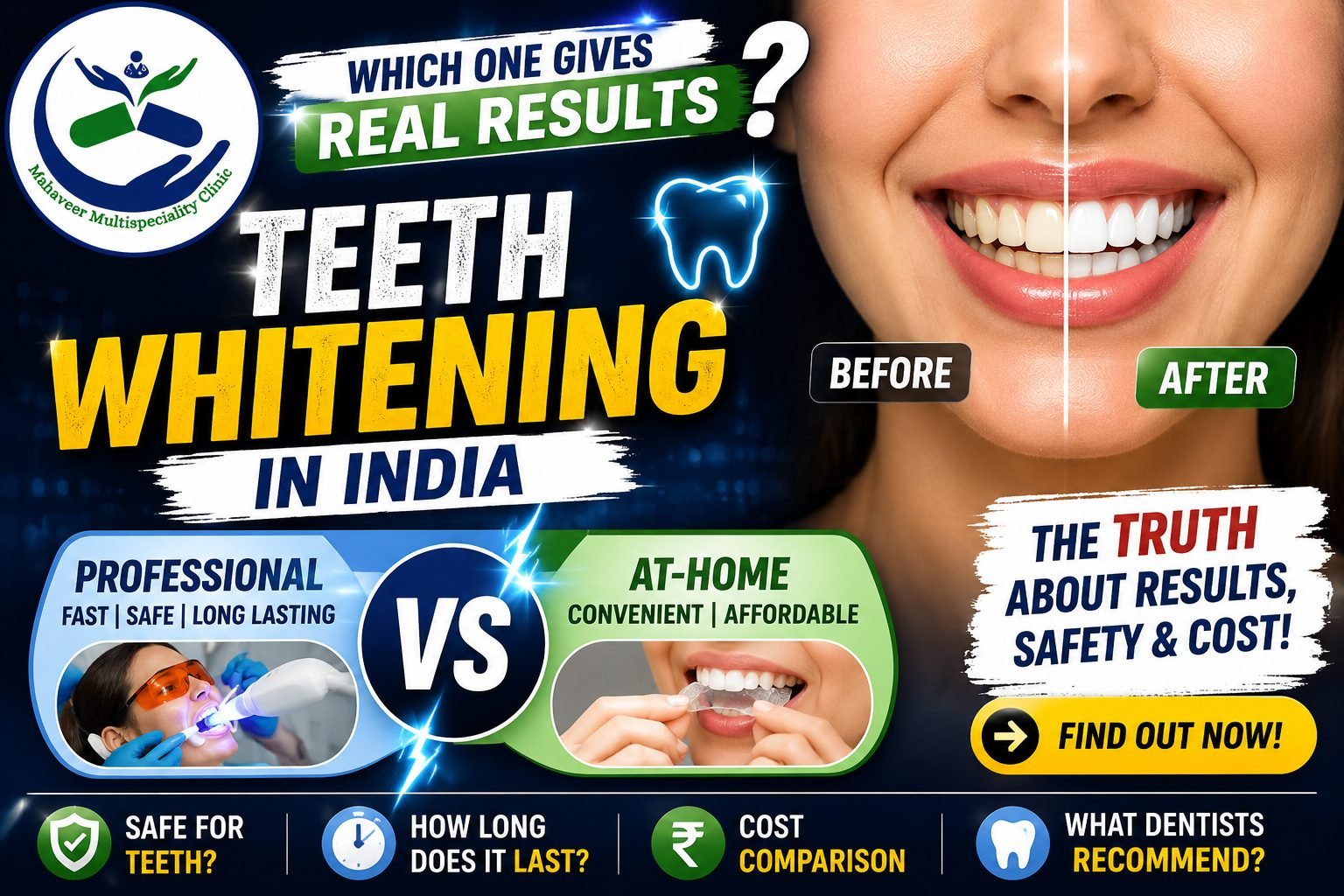
Walk into any pharmacy in India and you'll find a shelf of whitening toothpaste, whitening strips, charcoal powders, and LED whitening kits, each one promising the same thing: dramatically whiter teeth in days. Scroll through Instagram and you'll see the same promise, dressed up with a dramatic before-and-after slide.
Here's the uncomfortable part of that story: most of what's marketed as "teeth whitening" either does very little, does something completely different from what it claims, or works for a narrow set of stains that may not even be yours. We see the disappointment walk into our clinic regularly — patients who spent money on a kit, followed the instructions carefully, and still don't see the smile they were promised.
This article isn't a sales pitch for whitening. It's the version of this conversation we'd have with you in the chair — what actually works, what's a waste of money, what's genuinely risky, and how to read through the marketing noise before you spend on anything.
Why Teeth Actually Stain
Before you can judge whether a whitening product will work, it helps to understand what you're actually fighting. Tooth discolouration comes from two very different places, and this single fact explains most of the disappointment people feel with whitening products.
- Extrinsic stains sit on the outer enamel surface and come from tea, coffee, turmeric-heavy food, gutkha, tobacco, and red wine. These respond well to whitening.
- Intrinsic stains sit inside the tooth structure itself, caused by things like certain antibiotics taken in childhood, excess fluoride exposure, ageing, or trauma to a tooth. These respond much more slowly, if at all, to standard whitening.
A whitening kit that works beautifully for someone with tea-stained enamel can do almost nothing for someone with intrinsic staining — and marketing never tells you which category you fall into. A quick exam by a dentist does.
In Indian households specifically, a few habits show up again and again in our patients' staining patterns: multiple cups of chai through the day, turmeric and spice-heavy cooking, paan and gutkha use, and frequent snacking on foods that leave acidic residue on enamel. None of these are unusual or something to feel embarrassed about — they're simply useful information, because they tell us (and you) roughly what kind of staining we're dealing with and how well it's likely to respond to whitening.
5 Whitening Myths We Hear Every Week
Charcoal is abrasive. It can lift some surface stain, but with regular use it also wears down enamel, which can actually make teeth look more yellow over time by exposing the naturally yellower dentin underneath.
Strips use a much lower peroxide concentration than professional treatments, applied without any protection for your gums, and without anyone checking whether your specific stains will even respond.
Supervised whitening, done at the correct concentration, does not erode enamel. What damages enamel is unsupervised, excessive, or improperly mixed home use — not whitening as a procedure.
Whitening isn't permanent. Your teeth will gradually pick up new surface stains from food and drink just like before — the difference is how long that takes and how well you maintain it.
Lemon juice is acidic enough to soften enamel, and baking soda is abrasive. Used together and repeatedly, this combination can genuinely thin your enamel — the opposite of what people are trying to achieve.
How Professional Whitening Actually Works, Step by Step
Part of why professional whitening outperforms most home options isn't just the gel strength — it's the process around it. Here's what an in-clinic session actually involves, so you know exactly what you're paying for:
- Shade assessment. Your dentist records your current tooth shade against a standard shade guide, so there's an objective "before" to compare against.
- A quick oral health check. Cavities, exposed roots, or gum inflammation are ruled out first — whitening over an untreated problem causes unnecessary pain and poor results.
- Gum and lip isolation. A protective barrier or gel is applied to your gums so the whitening agent only contacts enamel, not soft tissue.
- Calibrated gel application. A peroxide-based gel, at a concentration appropriate for your teeth, is applied to the front-facing tooth surfaces.
- Activation and timing. Depending on the system used, the gel is left to work for a set, monitored duration, sometimes with a light to accelerate the reaction.
- Reassessment. Your shade is checked again against the same guide, so the improvement is measurable, not just a subjective "it looks brighter."
Every one of these steps is what a home kit skips, which is exactly why the two options aren't really comparable despite being marketed as interchangeable.
What Determines Your "Ceiling" Shade
This is the part almost nobody explains before you spend money: every person has a maximum natural shade their teeth can reach, no matter how many whitening sessions they do. It's determined by:
- The thickness and translucency of your enamel — thinner enamel shows more of the naturally yellower dentin layer underneath.
- Your dentin's base colour, which is largely genetic and doesn't change with whitening.
- How long-standing your staining is — years of accumulated stain take longer to lift than recent staining.
- Whether any intrinsic factors are involved, like old antibiotic exposure or fluorosis, which cap how much whitening can achieve.
Two people can do the exact same whitening treatment and end up with visibly different final shades — not because one product failed, but because their starting biology was different. This is precisely why a dentist examining your teeth before you commit to any whitening option matters more than the brand of gel you choose.
Professional vs At-Home, at a Glance
We cover the full side-by-side breakdown, including cost specifics, in our dedicated comparison guide for Mumbai patients. Here's the short version:
Professional Whitening
- Calibrated, higher-strength gel
- Gums protected during treatment
- Dentist confirms your stains will actually respond
- Results in a single sitting or short course
- Lasts 1–3 years with normal habits
At-Home Kits
- Lower, generic concentration for everyone
- No gum protection or fit customization
- No check on whether your stains will respond
- Slower, often uneven results over weeks
- Fades faster, typically within 4–6 months
Is Teeth Whitening Actually Safe?
Yes, when it's done properly. Whitening gels work through a peroxide-based bleaching reaction that lifts stain molecules trapped in the enamel. This process does not "dissolve" the tooth. The safety concerns that do exist are real, but they're about how whitening is done, not whitening itself:
- Gum irritation from gel touching soft tissue without proper isolation — common with ill-fitting home trays.
- Temporary sensitivity from the tubules in your teeth opening briefly during treatment — normal, and it settles within a day or two.
- Overuse damage from repeating high-strength treatments too often without a dentist's guidance.
- Uneven results around existing fillings, crowns, or caps, since these materials do not respond to whitening gel at all — a mismatch nobody warns you about until you see the difference in the mirror.
If you have active cavities, exposed roots, or untreated gum disease, whitening should wait until those are addressed — not because whitening is dangerous, but because it will be uncomfortable and the results won't hold. A quick checkup and cleaning before whitening is always worth doing first.
The Truth About Results Nobody Advertises
This is really the heart of what we want you to walk away with. Whitening is a genuinely effective, well-studied cosmetic treatment — but it has limits that marketing conveniently leaves out:
- Whitening only works on your natural tooth enamel. Crowns, veneers, bonding, and fillings will not change colour, which can leave a visible mismatch after whitening natural teeth around them.
- Results plateau. Beyond a certain number of sessions, more whitening does not mean more whitening effect — it just means more risk of sensitivity for no extra benefit.
- Everyone's "ceiling" shade is different, largely genetic. Whitening lightens your current shade; it does not give you a universal, identical white regardless of your starting point.
- Photos you see online are frequently edited, filtered, or a combination of whitening plus veneers or smile design work, not whitening in isolation.
None of this means whitening isn't worth doing — for the right candidate with realistic expectations, it's one of the highest-satisfaction, lowest-risk cosmetic treatments in dentistry. It just means going in with an accurate picture of what "success" actually looks like.
Mistakes That Waste Your Money
Who Shouldn't Whiten Right Now
Whitening isn't the right first step for everyone. We typically recommend waiting, or choosing a different approach entirely, if you have:
- Active cavities or untreated tooth decay
- Significant gum disease or inflammation
- Multiple visible crowns, veneers, or bonding on front teeth
- Very deep intrinsic staining that whitening realistically won't shift
- Pregnancy or breastfeeding (as a precaution, not a proven risk)
In several of these cases, options like veneers or a full smile design consultation deliver a more predictable, lasting result than whitening ever could.
How to Make Your Results Actually Last
Whichever route you choose, the treatment is only half the story — how you maintain it decides whether you're back to square one in three months or still smiling confidently a year later.
What Does Teeth Whitening Cost in India?
Pricing varies by city, clinic, and the whitening system used, but as a general guide across India: professional in-clinic whitening typically falls in a moderate range that reflects the calibrated gel, gum protection, and dentist supervision involved, while over-the-counter kits are cheaper upfront but often need repeat purchases since results fade faster and are less predictable. When you account for how much longer professional results last, the actual cost-per-month of white teeth often works out closer than the sticker price suggests. For an itemized cost breakdown specific to Mumbai clinics, our detailed pricing comparison covers this in depth.
So, What Should You Actually Do?
If your staining is mostly from tea, coffee, or food, and your teeth and gums are otherwise healthy, professional whitening is genuinely one of the best value cosmetic treatments available — predictable, fast, and safe when supervised. If you're dealing with old fillings, crowns, deeper intrinsic staining, or you want a more dramatic, permanent change, that's a different conversation, and it's worth having it with a dentist before you spend on a kit that was never going to work for your situation in the first place.
Our in-clinic teeth whitening at Thane West and Goregaon West starts with exactly this honest assessment, so you know what to expect before you commit to anything.
Frequently Asked Questions
When Whitening Isn't Enough: Other Options Worth Knowing About
Sometimes what people describe as "I want whiter teeth" is really a bigger ask — straighter-looking teeth, more even shape, or fixing a chip along with the colour. Whitening only ever changes shade; it doesn't reshape or realign anything. If your goals go beyond colour, it's worth knowing what else exists so you don't try to force whitening to do a job it was never meant for:
- Porcelain veneers can correct shade, shape, and minor spacing issues together, in one predictable, long-lasting result — a good option when whitening alone won't get you there.
- Digital smile design lets you preview a complete smile makeover, combining whitening with other cosmetic adjustments, before committing to anything.
- Composite bonding can mask localized dark spots or intrinsic stains on individual teeth that whitening skips over entirely.
None of these replace whitening for someone who just wants their natural teeth a few shades brighter — but knowing they exist prevents the common mistake of repeating whitening sessions again and again, hoping for a result that whitening was never capable of delivering in the first place.
Final Thoughts
Teeth whitening isn't a scam, and it isn't magic either — it's a well-understood cosmetic treatment with real, but bounded, results. The frustration most people feel comes from marketing promising more than biology can deliver, not from whitening failing as a concept. Know your stain type, know your ceiling shade, get your mouth checked first, and pick the option that matches your actual situation rather than the one with the best Instagram ad.
If you want an honest read on whether whitening will work for you specifically, and how much of a difference to realistically expect, that's exactly what a quick consultation is for.
Visit Mahaveer Multispeciality Dental Clinic
Mahaveer Multispeciality Dental Clinic
Shop No 1, Ashirwad, C.H.S. Ltd
Near Anand Hotel, Motilal Nagar II, Goregaon West, Mumbai, Maharashtra 400062
Contact: +91 90572 02410
Mahaveer Multispeciality Dental Clinic
Shop No. 5, Green Wood Complex, Oxford Society, A Wing, Manpada, Thane West, Thane, Maharashtra 400610
Contact: +91 86919 01509