

5 Early Signs of a Dental Cavity Most People in India Miss Until It's Too Late
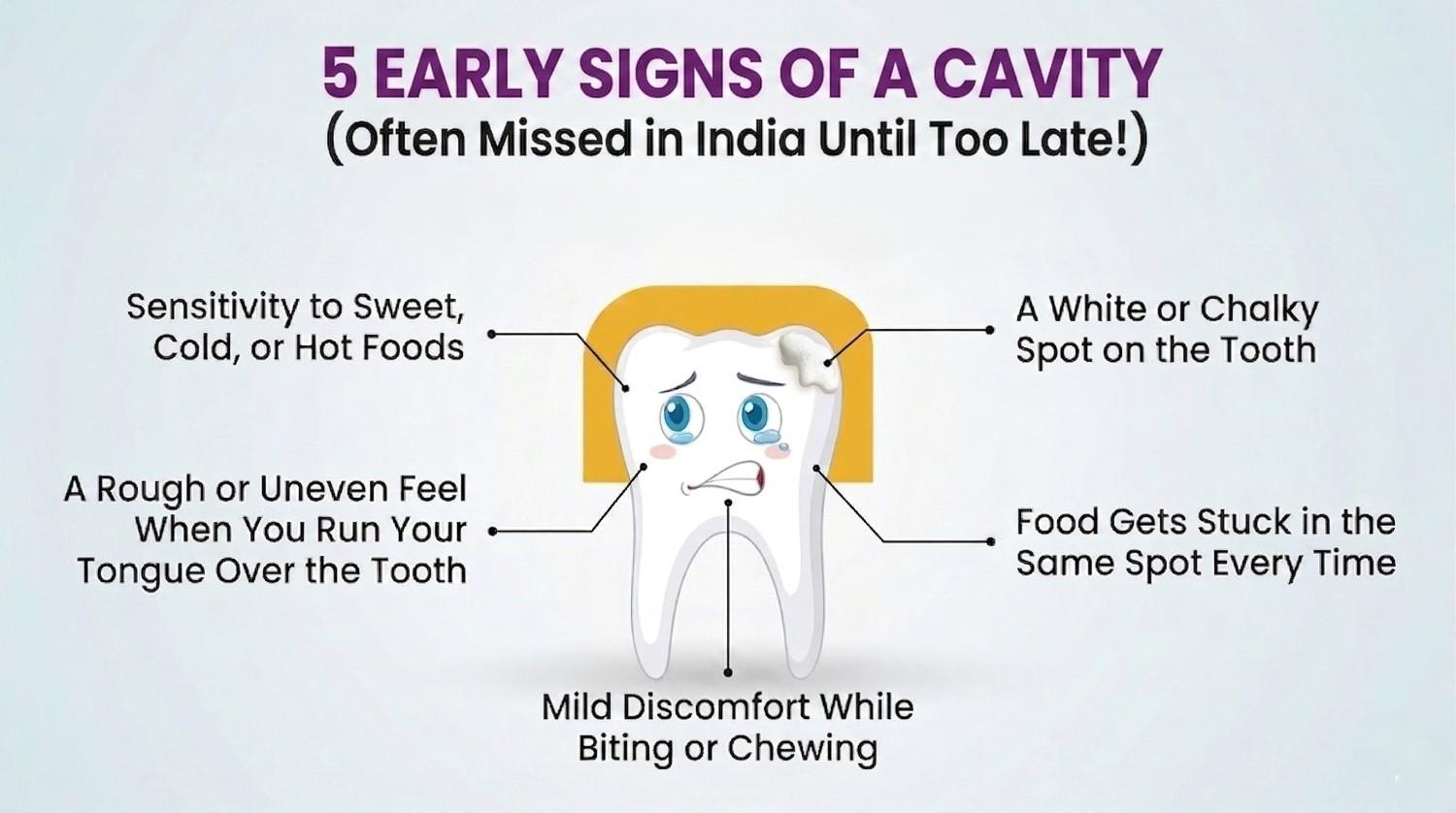
A dental cavity does not start with pain. That is the part most people get wrong. By the time a tooth actually hurts, the damage is already significant. What started as something tiny and treatable has now become something that needs much more time, money, and effort to fix.
This happens quietly, and it happens to a lot of people across India every single day. Not because they are careless, but because they simply do not know what to look for in the early stages. The signs are there. They are just easy to miss or dismiss.
In this blog, we will walk you through the 5 early warning signs that your tooth might be developing a cavity, explained in plain, clear language. No complicated words. Just what you actually need to know.
In This Article
- Why Cavities Start Without Any Pain
- Sign 1: Sensitivity to Sweet, Cold, or Hot Foods
- Sign 2: A White or Chalky Spot on the Tooth
- Sign 3: Food Gets Stuck in the Same Spot Every Time
- Sign 4: A Rough or Uneven Feel When You Run Your Tongue Over the Tooth
- Sign 5: Mild Discomfort While Biting or Chewing
- What Most People in India Do at This Point (And Why It Makes Things Worse)
- What Happens If a Cavity Is Ignored
- Frequently Asked Questions
Why Cavities Start Without Any Pain
This is the first thing to understand. A cavity does not begin as a hole. It begins as damage to the outer surface of your tooth, the hard, protective layer called enamel.
Enamel has no feeling in it. No nerves. So when decay first starts working on this outer layer, you feel absolutely nothing. There is no pain, no ache, no signal of any kind. Your tooth looks fine. You feel fine. But underneath the surface, something is happening.
It is only when the decay moves deeper, into the softer layer underneath the enamel, that the nerves start getting involved. And that is when the pain begins. By that point, the cavity has already been growing for months, sometimes longer.
This is why early signs matter so much. The signs that appear before pain starts are your only real warning window. If you catch it in that window, treatment is quick, painless, and inexpensive. A simple tooth filling is all it takes.
Sign 1: You Feel a Sharp Sensation When You Eat Something Cold, Sweet, or Hot
Think about the last time you had a cold drink or a piece of mithai. Did you feel a quick, sharp sensation on a particular tooth? A brief twinge that went away in a second or two?
Most people dismiss this as "sensitive teeth" and move on. But here is what that sensation often means: the protective outer layer of your tooth has started to weaken. When the enamel gets thin or develops a small area of damage, the inner part of the tooth becomes exposed to temperature and sugar.
That flash of discomfort is your tooth's way of reacting to what it should not be feeling. Healthy teeth with strong enamel do not send that sensation. When they do, it is a signal worth paying attention to.
This kind of sensitivity does not always mean a cavity. It can also point to other issues like a small crack in the tooth or gum recession. But all of those are reasons to see a dentist, not reasons to wait. Visit our dental services page to understand what a checkup covers.
Sign 2: You Notice a White or Slightly Dull Spot on the Tooth
This is one of the clearest early signs of a cavity, and it is also one of the most ignored ones simply because it does not look alarming. A small white or chalky area on the surface of a tooth looks almost like a light stain. People assume it is leftover food, a natural variation in the tooth colour, or something cosmetic. So they ignore it.
What is actually happening is this: the minerals that keep your enamel strong are being dissolved by the acid produced by bacteria in your mouth. When enamel starts losing its minerals, it turns white or dull in appearance. This is called early decalcification, and it is the very first visible stage of tooth decay.
At this point, the tooth surface has not yet broken down into a hole. It is still intact. With proper fluoride treatment and dental guidance, this stage can sometimes be reversed. But if ignored, it will progress into a real cavity within weeks or months.
You may not always be able to see this yourself, especially on the back teeth. This is one of the reasons why regular dental checkups and cleanings matter so much. A dentist can spot these changes before they become a full cavity.
Sign 3: Food Keeps Getting Stuck in the Same Spot
This is a very common experience and almost universally brushed off as a quirk of a person's bite. "Food just always gets stuck there," people say. And they clean it out and forget about it.
But when food consistently gets trapped in the exact same spot on the same tooth, every single time, it is usually not a coincidence. It often means that the surface of the tooth has changed. A tiny pit or groove has formed where food can collect. This happens in the very early stages of a cavity when the surface of the tooth starts breaking down, even before it becomes a visible hole.
The problem is not just the inconvenience. The food that gets stuck there feeds the bacteria that are already causing the damage. So the more often food collects there, the faster the decay progresses. It becomes a cycle.
If this is happening, the area deserves a closer look. A dentist can check whether a small indentation or forming cavity is responsible, and intervene before a filling becomes unavoidable. Learn more about what tooth fillings involve and how straightforward they are when caught early.
Sign 4: The Tooth Feels Rough or Uneven When You Run Your Tongue Over It
Most people do not consciously pay attention to how their teeth feel from the inside. But your tongue is actually quite good at detecting small changes in surface texture. If you run your tongue slowly over your teeth and notice that one particular tooth feels rough, pitted, jagged at a specific spot, or just different from how it used to feel, that is worth noting.
Healthy teeth feel smooth and even. When tooth enamel starts to break down, the surface becomes uneven. There may be a tiny pit forming, a chipped edge from where the enamel has weakened, or an area that simply does not feel like the rest of the tooth.
This roughness is the physical beginning of the cavity. The surface has started to break apart. It is not yet a deep hole, but the structural integrity of the tooth surface has already been compromised.
Sometimes people also notice a visible dark spot or discolouration at the rough area. That discolouration is often early decay. It can look grey, brown, or black. Do not wait for it to grow larger before getting it checked.
Sign 5: Mild Discomfort When You Bite Down or Chew
This sign is a little further along than the previous four, but it still counts as an early warning compared to full blown toothache. If you notice a slight twinge or mild discomfort when you bite down on something firm, or when you chew on a particular side of your mouth, it is your tooth telling you something has changed.
At this stage, the decay has moved a little deeper into the tooth and the pressure of biting is being transmitted to the affected area. It may not hurt badly. In fact, many people describe it as a "not quite right" feeling rather than actual pain. They just start unconsciously chewing on the other side to avoid that minor discomfort.
That shift in how you chew is actually your mouth's way of protecting the tooth. And it is a serious signal you should not ignore.
At this point, a filling can usually still solve the problem. But if chewing discomfort has been happening for several weeks, it is possible the decay has reached closer to the nerve, which would require a more detailed evaluation. The sooner you visit, the more options you have. You can book an appointment at Mahaveer Clinic for a thorough check, with no pressure and no judgment.
What Most People in India Do at This Point (And Why It Makes Things Worse)
We see this pattern constantly at our clinic. A patient notices one of these signs. Maybe the sensitivity, maybe the rough spot. They know something feels off. But they do one of the following things instead of visiting a dentist:
- Switch to a sensitivity toothpaste. These pastes can reduce the sensation, which actually hides the warning sign rather than fixing the underlying problem. The cavity continues to grow while the discomfort feels better.
- Wait for the pain to get worse before going. "If it really becomes a problem, I will go." But by the time the pain is bad enough to force a visit, the cavity has often reached the nerve, turning a simple filling into a root canal.
- Assume it will go away on its own. Teeth do not heal the way skin does. A cavity cannot disappear without treatment. It can only grow.
- Apply a home remedy like clove oil or warm salt water rinses. These can briefly soothe discomfort but do absolutely nothing to stop the decay.
None of these approaches are wrong out of bad intention. They come from a very Indian instinct to manage pain first and avoid doctors unless the situation becomes serious. But with teeth, this approach has real consequences in rupees, time, and sometimes in losing the tooth entirely.
What Happens If a Cavity Is Ignored at Each Stage
Here is the straightforward path a cavity takes when it is not treated, and what gets more complicated at each step:
| Stage | What Is Happening | What Treatment Looks Like |
|---|---|---|
| Very Early | White spot on enamel, no hole yet | Fluoride treatment, diet advice. Sometimes no drilling at all. |
| Early Cavity | Small hole forming in outer enamel. Sensitivity begins. | Simple tooth filling. Quick visit, minimal discomfort. |
| Moderate Cavity | Decay reaches the softer inner layer. Pain starts appearing. | Larger filling or partial crown. More time, more cost. |
| Deep Cavity | Decay near or touching the nerve. Significant pain. | Root canal treatment followed by a dental crown. |
| Advanced / Abscess | Infection has spread. Tooth may be crumbling or dead. | Tooth extraction possibly needed, then dental implant or bridge. |
The difference between stage one and stage four is often just a matter of months and hundreds or thousands of rupees. It is not a small difference.
Noticed Any of These Signs?
You do not need to wait for serious pain to visit us. At Mahaveer Multispeciality Clinic, we check for early cavity signs as part of every routine dental checkup. Early detection keeps things simple and affordable.
Book a Checkup at Thane or Goregaon Call: +91 86919 01509Why Cavities Are So Common in India Specifically
This is not about judging anyone's dental habits. It is about understanding context. Several things about everyday life in India make cavities more likely to develop without being noticed:
- Our diet is high in fermentable carbohydrates. Rice, wheat, sugar, mithai, chai with sugar through the day. Bacteria in the mouth feed on sugar and produce acid. More sugar means more acid, and more acid means faster enamel damage. This is covered in detail in our article on Indian diet habits that damage teeth.
- Many people brush only once a day. The standard recommendation is twice. Not brushing at night is particularly harmful because saliva production goes down during sleep, giving bacteria more time to work on teeth without the natural protection saliva provides.
- Very few people floss or use interdental cleaning. The spaces between teeth are where a large percentage of cavities begin. Brushing alone cannot reach them. Floss or a water flosser is needed for those areas.
- Dental checkups are usually reactive, not preventive. Going to the dentist only when something hurts means problems get discovered at later stages every single time. By then, they have moved well beyond what early treatment could have addressed.
None of this means that having cavities is inevitable. It means that being aware of these patterns, and making small corrections, makes a meaningful difference in whether early signs turn into full damage.
Quick Summary: The 5 Early Signs to Remember
- A quick sharp sensation when eating or drinking something cold, hot, or sweet
- A white, chalky, or dull patch on the surface of a tooth
- Food getting consistently stuck in the same spot every time you eat
- A rough, uneven, or slightly pitted feeling when your tongue touches a specific tooth
- Mild discomfort or a "not quite right" feeling when biting or chewing
Any one of these is a reason to visit a dentist. You do not need all five at once.
Frequently Asked Questions
The Bottom Line
A dental cavity does not appear overnight. It builds slowly, quietly, and without pain in its early stages. By the time it starts to hurt, it has already moved well past the stage where a simple filling could have solved it.
The five signs we discussed above are your window. They appear before the pain starts. They are your tooth's way of asking for help while help is still easy to give.
If any of those signs sound familiar, do not wait for it to get worse. And if none of them apply to you right now, that is a great reason to visit a dentist and confirm that everything is genuinely fine. Either way, a checkup is the right move.
At Mahaveer Multispeciality Dental Clinic, we see patients at both our Thane West and Goregaon West locations. We believe dental visits should be simple, comfortable, and affordable. Whether you are coming in for the first time or returning after a long gap, we meet you where you are and help you figure out the next step without making it complicated.
You Do Not Need to Wait for Pain. Come in Now.
Early detection is the kindest thing you can do for your teeth. Our team at Thane and Goregaon is ready to help, with patience, clear explanations, and treatment that fits your situation.
Book Your Dental Checkup Call: +91 86919 01509