

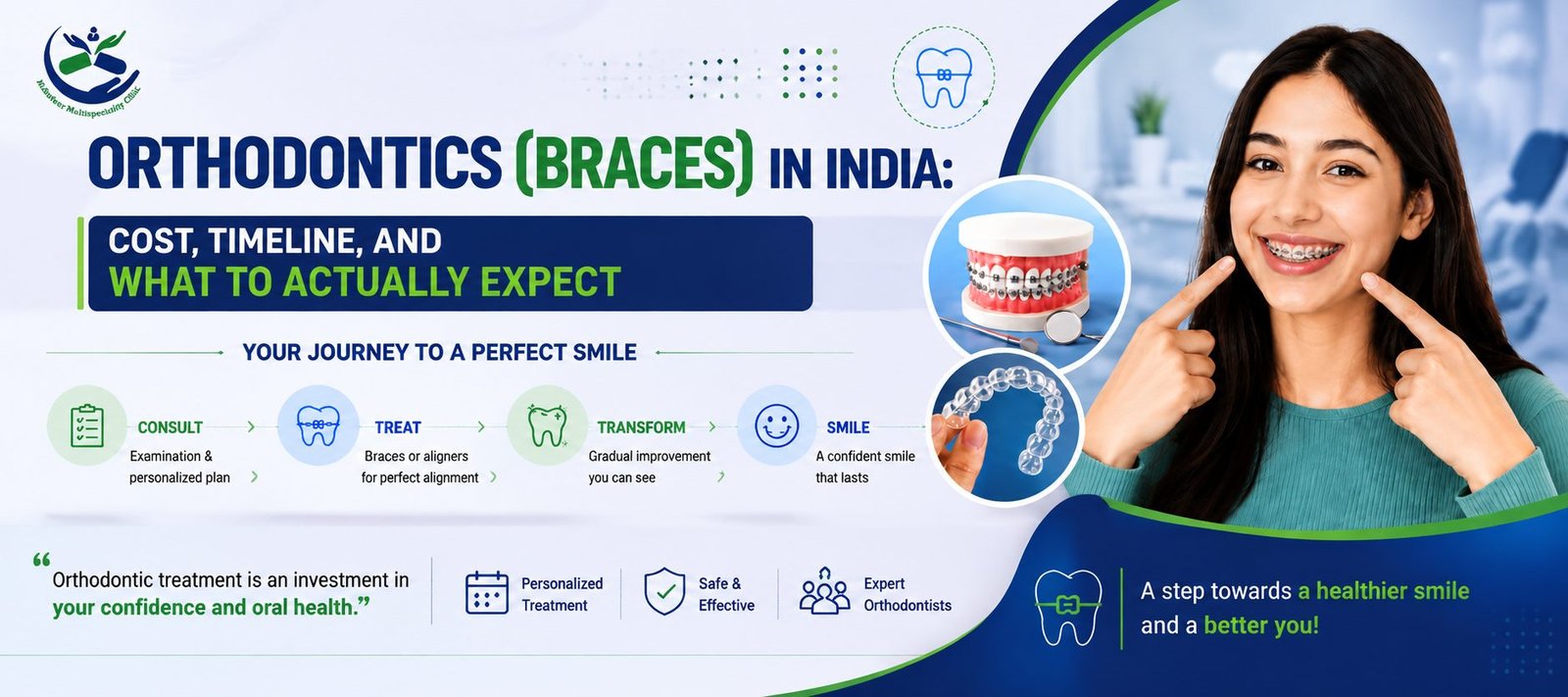
"How much will this actually cost me?" is almost always the second question we hear, right after "will it hurt?" And it's a fair question — braces are a real financial decision, not just a dental one, and most of the pricing information floating around online is either vague marketing copy or wildly out of date.
So here's the version of this conversation we'd actually have with you in the clinic: real cost ranges, an honest timeline, and what the months in between genuinely feel like — without the sales pitch and without the scare tactics.
If you want the full month-by-month clinical breakdown of treatment phases, we've covered that in detail separately in how long braces actually take in India. This article focuses on the two things people ask us about first: what it costs, and what it's really like to live with braces for a year or two.
What Braces Actually Cost in India
Let's start with real numbers instead of "it depends," even though it genuinely does depend on your case. Here's what patients across India typically pay for a complete course of treatment, based on appliance type:
| Braces Type | Typical Cost Range | Best Suited For |
|---|---|---|
| Traditional Metal Braces | ₹25,000 – ₹50,000 | Most cases, best value for money |
| Ceramic (Tooth-Coloured) Braces | ₹40,000 – ₹70,000 | Patients wanting a less visible option |
| Self-Ligating Braces | ₹45,000 – ₹85,000 | Fewer visits, sometimes faster treatment |
| Lingual Braces (Behind Teeth) | ₹90,000 – ₹1,80,000 | Completely invisible from the front |
| Clear Aligners | ₹60,000 – ₹1,80,000+ | Mild to moderate cases, removable convenience |
These are realistic ranges across Indian clinics, not the lowest possible price you could find or the highest premium option. For a number specific to your bite, a consultation with an orthodontist in Thane West or Goregaon West and an X-ray review is really the only accurate way to get there.
What Actually Drives the Price Up or Down
Two people can get the exact same type of braces and pay noticeably different amounts. Here's what actually moves the number:
- Case complexity. A mild crowding case costs less to correct than a full bite correction involving jaw alignment.
- Whether extractions are needed. Some crowded cases require removing one or more teeth to create space, which adds a step and a cost to the process.
- The clinic's location and reputation. A well-equipped specialty clinic in a metro city will typically cost more than a general dentist doing braces occasionally in a smaller town.
- The orthodontist's experience. Specialists with formal orthodontic training and years of case experience often charge more, and for complex cases, that experience is genuinely worth paying for.
- Additional procedures. Things like tooth extractions, minor gum treatment, or a crown needed before treatment starts will add to the total.
The honest advice here: don't chase the cheapest quote in your city. Orthodontic treatment done poorly doesn't just waste money, it can leave you with a worse bite than you started with, which then costs more to fix later.
Braces Types Compared, at a Glance
Traditional Metal & Ceramic Braces
- Most affordable option overall
- Handles even complex cases reliably
- Fixed to teeth, no discipline required to wear them
- Visible, though ceramic is far less noticeable
Clear Aligners
- Nearly invisible, removable for eating
- Generally costs more than metal braces
- Requires discipline — results depend on wear time
- Best for mild to moderate corrections
If you're weighing this decision specifically, our dedicated guide on clear aligners and Invisalign goes deeper into that comparison.
The Timeline, Realistically
Most people ask this expecting a single number, but the honest answer is a range, because it depends heavily on where your teeth are starting from. As a general guide:
- Mild crowding or spacing: 9 to 14 months
- Moderate crowding or bite correction: 15 to 20 months
- Complex cases involving jaw alignment or extractions: 20 to 30 months
Across all cases, the average Indian patient is looking at roughly 18 months of active treatment, followed by a retention phase with a retainer that, realistically, never fully ends — your teeth will always want to drift back over time without one. We break down every phase of this timeline, week by week, in our companion article on how long braces take in India, if you want the full clinical detail.
What Daily Life Actually Looks Like
This is the part that rarely gets an honest answer online. Here's what the day-to-day experience genuinely involves, based on what our patients tell us:
EMI and Payment Options
Given that orthodontic treatment often costs tens of thousands of rupees, paying the entire amount upfront isn't realistic for a lot of families, and it shouldn't have to be. Most established clinics, including ours, offer EMI and staged payment plans that spread the cost across the treatment duration — often aligned to your visit schedule, so you're paying gradually as treatment progresses rather than in one lump sum. If cost is the main thing holding you back from starting, it's worth asking about this directly during your consultation rather than assuming it isn't available.
What's Actually Included in the Price (And What Isn't)
One of the most common sources of frustration we hear about from patients who've been treated elsewhere isn't the price itself — it's discovering, halfway through treatment, that things they assumed were included actually weren't. Before you commit anywhere, get clarity on these specifically:
- Initial records and X-rays — sometimes billed separately from the treatment cost itself.
- Monthly or six-weekly adjustment visits — usually included, but worth confirming there's no per-visit charge.
- Retainers after debonding — a genuinely common add-on cost that can catch people off guard, often ranging from a few thousand rupees to significantly more for premium retainer types.
- Emergency visits for a broken bracket or poking wire — some clinics include these, others charge per visit.
- Refinement aligners or extra wire changes if your case needs adjustment beyond the original plan.
Ask for this breakdown in writing before you start. A clinic that's upfront about it isn't trying to hide anything; a clinic that's vague about it usually is.
Does Cost Vary Between Cities in India?
Yes, noticeably. Metro cities like Mumbai, Delhi, and Bangalore generally run higher than tier-2 and tier-3 cities, partly due to clinic overheads and partly due to demand. Within Mumbai itself, costs can vary between a clinic in a premium South Mumbai location versus a suburb like Thane or Goregaon, sometimes by a meaningful margin for the exact same treatment quality. This isn't necessarily a reason to travel for cheaper treatment — the logistics of 15 to 20 monthly visits over a year or more make a nearby, reliable clinic far more practical than chasing the lowest quote in a city you'd need to travel to repeatedly. What matters more than the city is transparent pricing and an orthodontist you trust to see the treatment through properly.
Braces Myths That Confuse the Cost Conversation
A few misconceptions come up constantly when people are trying to budget for treatment, and they're worth clearing up directly:
Not always true. Cost differences often reflect the orthodontist's experience, the quality of materials, and how much time is spent on treatment planning — all of which affect your actual outcome, not just the appliance's appearance.
Not necessarily. Aligner speed depends entirely on consistent wear time. Traditional braces, since they're fixed, don't rely on patient discipline the same way and can sometimes finish complex cases faster.
Retainers are part of the real cost of treatment, not an optional extra. Budgeting for at least one retainer, and potentially a replacement every few years, should be part of your planning from day one.
Mistakes That Cost You More
Kids, Teens, and Adults: Does Age Change Anything?
Orthodontic treatment works at almost any age, but the context shifts. For children, we often recommend an early evaluation around age 7 to catch developing jaw issues while growth can still be guided, which is a core part of what our pediatric dental team looks for during routine checkups, even before braces are actually needed. Teenagers are the most common age group for full treatment, since most permanent teeth are in by then. Adults can absolutely get braces too, and cost is usually similar to teen treatment for the same appliance, though timelines can run slightly longer if there's existing gum recession or bone loss to work around.
Choosing the Right Clinic for the Cost You're Paying
Since you're spending a meaningful amount of money either way, it's worth being deliberate about where you get treated. Look for a clinic that gives you a clear, written cost estimate after examination rather than a vague number over the phone, shows you before-and-after cases similar to yours, explains what's included in the price (retainers, emergency visits, adjustments) rather than surprising you with add-ons later, and offers a genuine consultation rather than a rushed sales pitch. Our own braces treatment at Thane West and Goregaon West is built around exactly this — a transparent cost breakdown before you commit to anything.
Frequently Asked Questions
How the Process Actually Starts
Before any cost estimate becomes real or any timeline actually begins, here's what the first few steps genuinely look like:
- Initial consultation. A visual exam, a discussion of what's bothering you about your bite or smile, and an honest assessment of whether treatment is even needed right now.
- Records and X-rays. Photographs, dental X-rays, and sometimes 3D scans to map exactly what's happening beneath the surface.
- Treatment planning. This is where your orthodontist decides on the appliance type, estimates the timeline, and puts together the actual cost breakdown specific to your case.
- The appointment where braces go on. Typically 60 to 90 minutes, not painful, though your mouth will feel unfamiliar for the rest of that day.
- Ongoing adjustment visits. Short, routine appointments every 4 to 6 weeks to tighten wires, swap aligner trays, or check progress.
Knowing this sequence in advance makes the whole process feel far less like a mystery, and it's exactly why the consultation step matters so much — it's where your actual cost and timeline stop being a general range and become a specific plan.
Is It Worth the Cost?
We're obviously not a neutral party here, so take this with that in mind — but genuinely, most patients who complete treatment tell us the same thing: they wish they'd started sooner. A corrected bite isn't just cosmetic. Crowded or misaligned teeth are harder to clean properly, which raises your long-term risk of cavities and gum disease, and can strain your jaw joint over years of uneven biting force. Looked at over a ten or twenty year horizon rather than just the treatment period, braces often work out to be one of the more cost-effective dental investments you can make, simply because a well-aligned bite tends to need less restorative work down the line.
That said, it's a genuine financial decision, and you're allowed to take your time with it. What we'd suggest is not letting cost uncertainty be the reason you delay a consultation — get the real number for your specific case, then decide with actual information instead of assumptions.
Final Thoughts
Braces are one of those treatments where the price tag looks intimidating until you break it down against how long the results last — often for the rest of your life, with a bit of retainer discipline. The cost varies genuinely based on your case, not just marketing, and the timeline is measured in months, not weeks, so patience is part of the deal from day one.
If you've been putting off a consultation because you're worried about the number you'll hear, that's exactly the conversation worth having sooner rather than later — an accurate estimate almost always looks more manageable than the vague number people imagine in their head.
Visit Mahaveer Multispeciality Dental Clinic
Mahaveer Multispeciality Dental Clinic
Shop No 1, Ashirwad, C.H.S. Ltd
Near Anand Hotel, Motilal Nagar II, Goregaon West, Mumbai, Maharashtra 400062
Contact: +91 90572 02410
Mahaveer Multispeciality Dental Clinic
Shop No. 5, Green Wood Complex, Oxford Society, A Wing, Manpada, Thane West, Thane, Maharashtra 400610
Contact: +91 86919 01509