

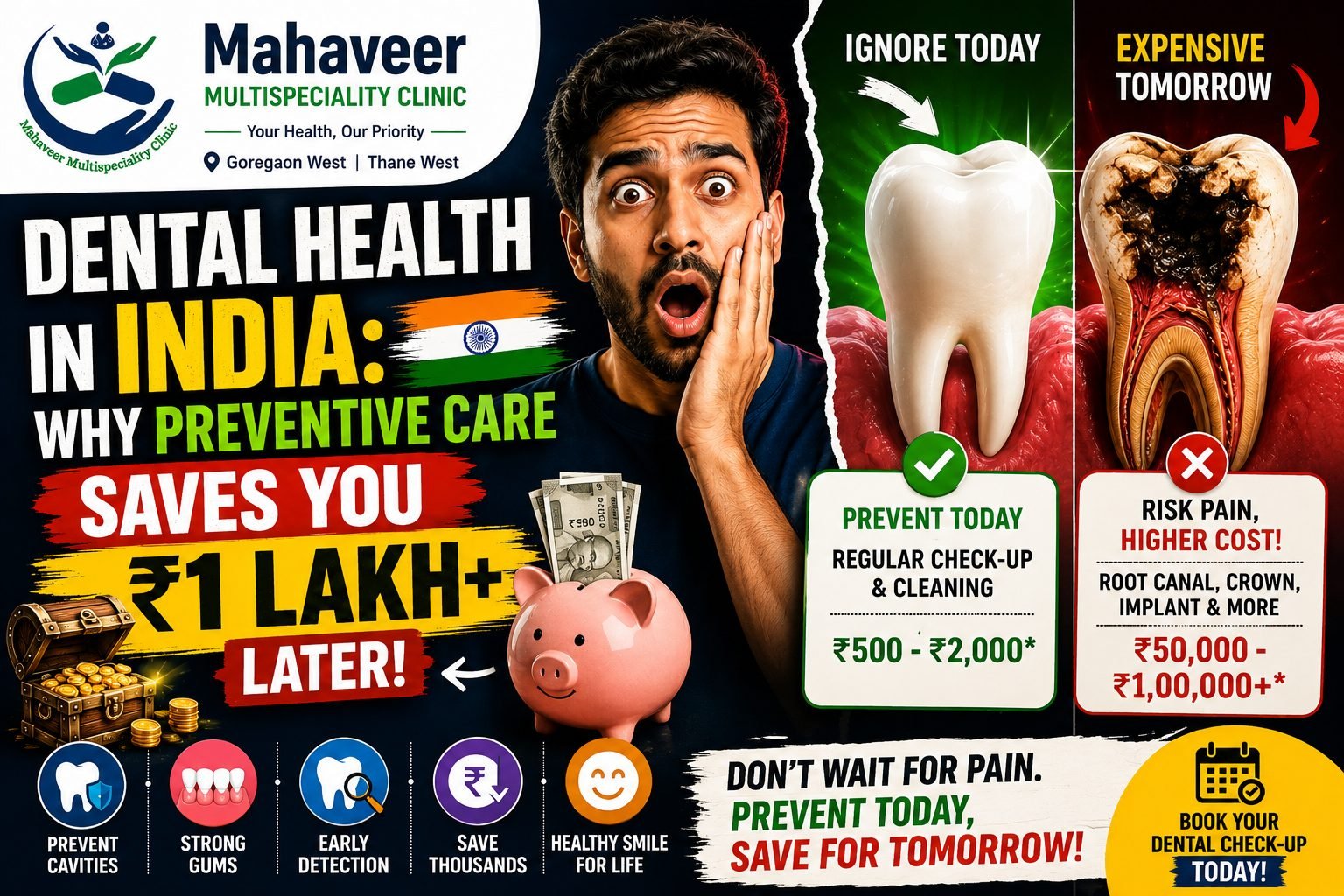
I'll say this upfront, because it's the honest truth after years of sitting across the dental chair from patients: almost nobody comes to see us for a checkup. They come because something finally hurts.
And by the time something hurts, the ₹800 filling we could have done two years ago has usually turned into a ₹15,000 root canal and crown. Sometimes worse. That's not a scare tactic — it's just what the X-ray shows, again and again, week after week, in both our Thane West and Goregaon West clinics.
This article is not going to lecture you about brushing twice a day like a textbook. You already know that. What I actually want to walk you through is the economics of preventive dental care — why it's the single most under-rated thing you can do for your health and your wallet, and exactly what it looks like in practice for a family living in India today.
Why Is Preventive Dental Care Important?
Here's the part that surprises most people: dental disease is almost always silent in its early stages. A cavity doesn't announce itself. Gum disease doesn't either. Your tooth can be quietly decaying from the inside for months, sometimes years, before a single nerve ending tells you something's wrong.
By the time you feel pain, the problem has usually already reached a point where a simple filling is no longer an option. That's the entire logic behind preventive dental care — it's not about waiting for something to hurt, it's about catching what's happening before it hurts.
Think of it the same way you'd think of a car service. You don't wait for the engine to seize before you change the oil. A dentist doing a six-monthly check is doing the same thing — catching small wear-and-tear before it becomes a breakdown.
What Actually Counts as Preventive Dental Care?
Preventive dentistry isn't one single thing. It's a handful of small, unglamorous habits and appointments that, together, do almost all the heavy lifting. Here's what it actually includes:
Routine Checkups
A visual and X-ray exam every six months to catch cavities, cracks, or gum issues while they're small.
Professional Cleaning
Removes hardened plaque (tartar) that a toothbrush physically cannot reach, protecting your gums from disease.
Fluoride Treatment
Strengthens enamel and makes teeth more resistant to the acid attacks that cause cavities.
Dental Sealants
A thin protective coating on the chewing surface of molars, especially valuable for children and teens.
Diagnostic X-rays
Reveals decay between teeth and below the gumline that's completely invisible to the naked eye.
Home Care Guidance
Personalized advice on brushing technique, flossing, and diet based on your specific mouth, not generic advice.
How Regular Dental Checkups Save You Money
This is the part I actually sit down and explain to patients with a pen and paper, because numbers make it real in a way that "prevention is better than cure" never quite does. Here's a genuinely representative comparison of what we see in practice:
| If Caught Early (Preventive) | Approx. Cost | If Left Untreated (Reactive) | Approx. Cost |
|---|---|---|---|
| Routine checkup & cleaning | ₹500 – ₹2,000 | Root canal + crown after infection | ₹15,000 – ₹35,000 |
| Small tooth-coloured filling | ₹1,000 – ₹3,000 | Deep decay needing extraction | ₹3,000 – ₹8,000 |
| Early gum treatment & scaling | ₹1,500 – ₹4,000 | Advanced gum disease management | ₹10,000+ |
| Missing tooth flagged early | Consultation only | Dental implant after years of gap | ₹25,000 – ₹60,000+ |
Notice the pattern? In every single case, the preventive route costs a fraction of the reactive one — and that's before we even talk about the extra time off work, the multiple visits, and honestly, the pain that comes with waiting. This is the real answer to how regular dental checkups save money: it isn't one big saving, it's dozens of small problems that never get the chance to become big, expensive ones.
How to Avoid Expensive Dental Treatment
If you want a straightforward, no-nonsense answer to how to avoid expensive dental treatment, here is the actual process we recommend to every patient at our clinic — not complicated, just consistent.
- Book a checkup every six months, even with zero symptoms. This is non-negotiable. It's the single biggest lever you have.
- Get professional cleaning done at each visit. Plaque that hardens into tartar cannot be removed at home no matter how well you brush.
- Treat small problems the moment they're found. Don't "wait and watch" a cavity that's already been flagged — that waiting is exactly what turns a ₹1,500 filling into a ₹20,000 root canal.
- Fix your brushing technique, not just your brushing frequency. Most people brush twice a day and still get cavities because the technique or the toothbrush angle is wrong. Ask your dentist to actually show you, once.
- Cut down on constant grazing, especially sugary tea and snacks. It's not just what you eat, it's how often your teeth are exposed to acid throughout the day.
- Don't ignore bleeding gums. Bleeding while brushing is not "normal" — it's the earliest visible sign of gum disease, and it's completely reversible if caught now.
- Replace a missing tooth sooner rather than later. An empty gap doesn't just sit there quietly — it lets neighbouring teeth drift, which creates new problems and a more complex, more expensive fix down the line.
Cavity Prevention: What Actually Works
Cavity prevention gets a lot of generic advice thrown at it, so let me narrow it down to what genuinely moves the needle, based on what we actually see reverse or stall in patients' mouths:
- Fluoride toothpaste, used correctly — not rinsing immediately after brushing gives fluoride time to actually work on the enamel.
- Flossing daily, because a toothbrush simply cannot reach the contact points between teeth where a large share of cavities start.
- Dental sealants for children and cavity-prone adults — a thin coating that physically blocks food and bacteria from settling into the deep grooves of back teeth.
- Limiting snacking frequency, not just sugar quantity — your mouth needs gaps between meals to neutralize acid naturally.
- Professional cleaning every six months to interrupt plaque buildup before it mineralizes into tartar.
Combined, these habits prevent the overwhelming majority of cavities we would otherwise be treating with fillings, or worse.
Preventive Dentistry Myths vs. Facts
A lot of the resistance to preventive dentistry comes from things people genuinely believe, not laziness. Let's clear a few of these up directly:
| Myth | Fact |
|---|---|
| "If it doesn't hurt, it's not a problem." | Most cavities and gum disease are painless until they're advanced. Absence of pain is not the same as absence of disease. |
| "Checkups are only needed if something feels wrong." | Checkups exist specifically to catch problems before they feel wrong — that's the entire purpose of preventive dentistry. |
| "Baby teeth don't matter since they fall out anyway." | Untreated decay in baby teeth can affect the permanent teeth growing underneath and lead to early, painful extractions. |
| "X-rays are only needed if there's a visible problem." | X-rays catch decay between teeth and below the gumline, areas that are completely invisible during a normal visual exam. |
| "Once I have a filling or crown, that tooth is done for good." | Fillings and crowns still need regular monitoring — decay can develop at the edges of an old filling just like on natural enamel. |
Family Dental Care: What Preventive Care Looks Like by Age
One thing I always tell parents: preventive dental care isn't a one-size-fits-all routine. What your 6-year-old needs is different from what you need, which is different again from what your parents need. Here's how we actually break it down for family dental care:
| Age Group | Preventive Focus |
|---|---|
| Children (2–12 yrs) | Sealants, fluoride, cavity checks, building brushing habits early — see our pediatric dentistry care. |
| Teens (13–19 yrs) | Cavity monitoring, wisdom tooth tracking, guidance on diet and habits like fizzy drinks. |
| Adults (20–50 yrs) | Gum health monitoring, wear-and-tear checks, managing stains from tea, coffee, or tobacco. |
| Seniors (50+ yrs) | Bone density and gum recession checks, denture/implant fit, more frequent monitoring overall. |
If you're booking for the whole family, it genuinely helps to bring everyone in around the same time — it makes it a habit for kids to see checkups as routine, not something scary reserved for when there's pain.
Dental Health in India: Why This Matters Even More Here
I'll be direct about something specific to dental health in India: our diet and habits work against us in ways that are easy to overlook. Frequent chai through the day, a diet rich in sweets and refined carbohydrates, paan and tobacco use in some households, and a cultural tendency to visit a dentist only in an emergency — all of this adds up. We've written in more depth about this in our piece on Indian diet habits that damage teeth, and honestly, it's one of the most common patterns we see walk through our doors.
Preventive dental care matters everywhere, but in a country where "the dentist" is still often thought of as someone you see only for a toothache, shifting that mindset to routine, scheduled care is where the real savings — in money, in pain, in time — actually happen.
There's also a generational pattern we notice, especially in families that come to us across two or three generations. Grandparents often grew up with almost no access to regular dental care, so a lot of the damage they carry today is the direct result of decades without checkups. Parents are somewhere in between — more aware, but still mostly reactive. It's usually the youngest generation, when parents actively bring their kids in from an early age, that ends up with genuinely healthy, cavity-free mouths well into adulthood. That shift, across just one generation, is entirely achievable, and it costs far less than most people assume.
Insurance coverage for dental treatment is also still limited for a lot of Indian families, which makes the financial argument for prevention even stronger. When a root canal or an implant comes almost entirely out of pocket, the ₹500 checkup that could have prevented it stops looking optional and starts looking like the obvious choice.
Excuses We Hear All the Time (And the Honest Truth Behind Them)
After enough years in this chair, you start hearing the same handful of reasons on repeat. I'm not saying this to embarrass anyone — I've probably thought some of these myself about my own health at some point. But it helps to say the honest version out loud.
Pain is usually the last symptom to show up, not the first. Cavities, gum disease, and even cracked teeth can sit quietly for a long time before you feel anything. By the time it hurts, it's rarely the cheapest stage to treat.
A preventive visit takes 30–40 minutes. A root canal and crown, once it's needed, takes multiple visits spread over weeks. Ironically, skipping the checkup to "save time" almost always costs more time later.
A checkup and cleaning is nowhere close to the cost of a root canal, crown, or implant. We've laid out the actual numbers above — the gap isn't small, it's often ten to twenty times the cost.
Brushing is necessary but not sufficient. It doesn't reach between teeth, it doesn't remove hardened tartar, and it can't spot decay happening below the surface. That's precisely what a dentist is trained to catch that you can't see in a mirror.
Signs You Shouldn't Wait On
Preventive care doesn't mean ignoring symptoms when they do show up. If you notice any of the following, don't wait for your next scheduled checkup — book an appointment sooner:
- Bleeding gums while brushing or flossing
- Sensitivity to hot, cold, or sweet foods that lingers
- Visible dark spots or pits on teeth
- Bad breath that doesn't go away with brushing
- A tooth that feels "different" when you bite down
- Any swelling in the gums or face
Frequently Asked Questions
Final Thoughts
If there's one thing I'd want you to take away from this, it's not a statistic — it's a mindset shift. Stop thinking of the dentist as someone you visit when something goes wrong. Start thinking of preventive dental care the way you think of any routine maintenance: small, boring, consistent, and dramatically cheaper than the alternative.
Your teeth are quietly telling you something every single day — whether there's a small crack forming, a patch of enamel wearing thin, or gums that are just slightly more tender than they should be. A six-monthly checkup is simply how you actually listen.
Visit Mahaveer Multispeciality Dental Clinic
Mahaveer Multispeciality Dental Clinic
Shop No 1, Ashirwad, C.H.S. Ltd
Near Anand Hotel, Motilal Nagar II, Goregaon West, Mumbai, Maharashtra 400062
Contact: +91 90572 02410
Mahaveer Multispeciality Dental Clinic
Shop No. 5, Green Wood Complex, Oxford Society, A Wing, Manpada, Thane West, Thane, Maharashtra 400610
Contact: +91 86919 01509